


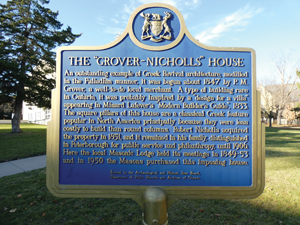
 An outstanding example of Greek revival architecture, modified in the Palladian manner, it was begun about 1847 by P.M. Grover, a well-to-do local merchant. A rate type of building in Ontario, the square pillars are a classical Greek feature popular in North America principally because they were less costly to build than round columns. Robert Nicholls acquired the property in 1851 and it remained in his family until 1906. The Nicholls were distinguished in Peterborough for public service and philanthropy. In 1853 Robert Nicholls, a wealthy merchant, and his wife Charlotte Jane moved in and added the two side wings and front porch.
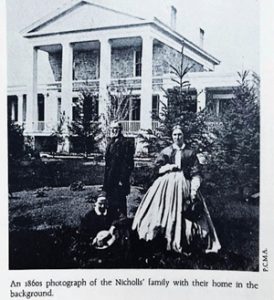
Courtesy P.C.M.A.
After Robert’s death in 1883, Charlotte Jane Nicholls, now a wealthy widow, became Peterborough’s most well-known benefactor at the time. Her financial position allowed her to devote much of her time and money to the welfare of the city. In 1885 she gave more funding to the city for a Protestant hospital in memory of her husband. In 1889 she expanded the now-inadequate facility by paying for a 50-bed hospital on Argyle Street. The Nicholls Hospital was expanded twice after she died and was the forerunner of today’s civic hospital. She contributed both during her life and through her will to the YMCA, the Presbyterian Church, many charities and numerous educational institutes. The name Nicholls will be long-remembered in Peterborough, both because the benefactions of Robert and Charlotte Jane exceeded all others, and because their home remains one of the principal architectural landmarks in the province. Charlotte Jane Nicholls lived in the house until her death in 1890.

Related Posts


