


Inside AI – George Irish
By George Irish
“We want to start using AI, but we don’t know where to begin.”
Lately, many of my conversations with nonprofit fundraisers have started this way.
I think it marks the moment where artificial intelligence (AI), including ChatGPT, has become more than a buzzword and is now a real, emerging priority.
There are plenty of good reasons why nonprofits haven’t started working with AI. The technology is still relatively new and unfamiliar to many, and the rapid pace of change can feel overwhelming. Concerns about bias in AI algorithms, copyright issues surrounding AI-generated content, and the potential for AI to produce inaccurate or misleading information (“hallucinations”) are all legitimate worries.
Nonprofits are often stretched thin, with limited resources and competing priorities. Adding AI exploration to an already overloaded plate can seem daunting. The lack of in-house AI expertise and the perceived complexity of implementing new tools can also be significant barriers.
However, industry trends show us that AI use is rapidly expanding. The recently released 2024 Microsoft/LinkedIn World Trend Index reports a 50 percent increase in knowledge workers using AI in the last six months.
In my own survey of nonprofit fundraisers, I have found that up to 20 percent already started experimenting openly with AI in their teams and are sharing learnings. Another 25 percent admit they’ve used AI but haven’t disclosed it. Only about 30 percent are not using it at all, and 25 percent say they’ve used it, but only for personal use.
Another emerging trend is ‘Bring Your Own AI’ (BYOAI), where workers use their personal AI tools for work purposes, often without official oversight, because such tools are not provided or permitted by their workplace. This seems to be a very common practice – with up to 80 percent of AI-users admitting to some BYOAI use.
So the “when should we start” question might be too late. AI adoption is already happening.
And it’s great that we’ve reached this point. This is where the real work begins.
Using AI with purpose and confidence
Let’s revise that opening question to: “How can we get started using AI purposefully and confidently to further our organization’s mission?”
Using AI purposefully means aligning it with your core values and strategic goals. Identify specific challenges or opportunities where AI can make a tangible difference in your work, whether it’s automating time-consuming tasks, uncovering hidden insights in your data, or enhancing your communication and outreach efforts. Approach AI not as a shiny new toy, but as a powerful tool that can be strategically deployed to further your mission.
Using AI confidently requires a foundation of knowledge and understanding. It means being aware of the potential risks and limitations of AI, such as bias, accuracy, and ethical considerations. Invest in training and education for your team so they can use AI tools effectively and responsibly. Foster a culture of continuous learning and adaptation, where you’re constantly evaluating and refining your AI strategies to ensure they align with your evolving needs and priorities.
These are long-term principles to guide your organization’s AI learning journey.
But first, you need to get started. Here are three critical ‘first steps’:
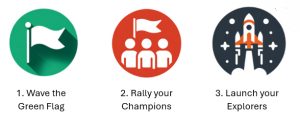 1. Wave the Green Flag
A critical first step is for senior leadership to signal that AI adoption is a priority and give the go-ahead to start exploring its potential. Without clear direction, staff may be unsure if AI use is safe or even allowed. This can lead to a fragmented approach, with individuals experimenting in isolation and not sharing their learnings.
Waving the green flag means creating a unified, transparent environment where AI use is openly discussed and solutions are explored collectively.
This could take the form of a policy statement from leadership, guidelines issued to managers, or even a placeholder “AI Mandate” like this one shared recently by social sector leader Rich Leimsider:
- AI use and experimentation is encouraged.
- Never enter private client data.
- You are responsible for the quality of your work, even if AI helps.
- All of our other policies about data privacy and presenting accurate work apply here, too.
- If you share any AI-supported work internally, you must disclose it – but if it is good, you will be praised, not criticized.
- Don’t share anything AI-created externally if it would be embarrassing if you had to disclose that AI helped you.
Adapting this simple ‘placeholder’ mandate to your organization’s context may give staff the clarity they need to begin exploring AI safely and with confidence. It doesn’t replace the need for a robust AI Policy at some point down the line, but it may be enough to get your learning journey started.
Why This Matters
Establishing a clear and supportive stance from leadership on AI isn’t just a suggestion, it’s a necessity. Waving the green flag mitigates risks and addresses concerns about data security, privacy, and ethical use head-on, fostering trust.
Openly embracing AI sends a powerful message that your organization is forward-thinking and adaptable to new technologies, attracting talent and fostering a sense of excitement about the future. Ultimately, a coordinated approach to AI adoption leads to streamlined workflows, data-driven decision-making, and a greater impact on your organization’s mission.
2. Rally Your Champions
Identifying and empowering your AI champions is another critical step in your organization’s AI journey. These “secret cyborgs,” as Ethan Mollick aptly calls them, are the individuals who have already embraced AI in their personal or professional lives. They possess a wealth of knowledge and experience that can propel your organization forward.
Here’s how to harness your champions’ potential:
- Find Them: Look for signs of AI enthusiasm. It could be the person who always knows about the latest tech trends, the one who’s experimenting with ChatGPT in their spare time, or the colleague who has found clever ways to automate mundane tasks.
- Create a Safe Space: Encourage open dialogue about AI. Host informal lunch-and-learns, create a dedicated Slack channel, or establish an “AI Explorers Club.” Make it a place where people feel comfortable sharing their discoveries, successes, and even failures.
- Learn while doing: Give your champions the freedom to explore AI tools and applications relevant to their roles. Encourage them to test new ideas, pilot projects, and report back on their findings.
- Celebrate Successes (and Failures): When AI experiments yield positive results, be sure to share those stories. Celebrate the individuals involved and showcase how AI is making a difference. Equally important, create a culture where it’s okay to fail. Learning from mistakes is a crucial part of innovation.
- Foster Collaboration: Encourage your champions to share their knowledge and expertise with others. Pair them with colleagues who are eager to learn, create mentorship opportunities, or host workshops to demystify AI.
Why This Matters
The rise of AI mirrors the adoption of social media and mobile technology. It’s not a technology strategy dictated from the top down; it’s growing from the grassroots up.
Your champions are the ones who will identify the most relevant use cases, experiment with different tools, and ultimately drive the adoption of AI within your organization. By embracing their enthusiasm and expertise, you’re not just implementing a new technology; you’re fostering a culture of innovation and continuous learning.
3. Launch your Explorers
Get your AI journey started by providing access to the AI tools your innovators need for testing and piloting. User accounts with ChatGPT (or other chatbots like Copilot, Gemini, or Claude) aren’t just a suggestion, they’re a strategic imperative.
Encourage your early adopters to dive in and interact with these tools as active participants, not passive observers. Explore the potential of chatbots with open-ended prompts like “How can you help me do my job?” Fostering a sense of curiosity and exploration, you invite innovation and discovery.
Beyond chatbots, consider testing AI-powered apps built for nonprofit fundraisers — find an updated list at: FundraisingwithAI.com/apps. As well, encourage your explorers to try new AI-powered assistants in familiar programs like Microsoft Office 365 or Google Workspace. This approach exposes your team to a wide range of AI applications and different ways to integrate AI into their workflows.
Focus your explorations around these areas:
- Content Creation (appeals, thank you notes & social media): AI excels at generating text, from drafting compelling appeals and personalized thank-you notes to crafting engaging social media posts and website content.
- Strategy: AI can be a valuable partner in strategic planning, helping brainstorm ideas, analyze potential scenarios, and even provide a structured framework for decision-making.
“Help me write a strategy for our year-end fundraising campaign. Ask me questions to gather the information you need, then give me an overview of the whole plan. Our goals are…” - Document and Data Analysis: AI can quickly sift through large documents and datasets, identifying patterns, trends, and correlations that might be missed by human analysts. This can lead to valuable insights about donor behavior, fundraising effectiveness, and program impact.
Why This Matters
Hands-on experience with AI tools is essential for understanding their capabilities and uncovering their practical applications.
Providing access and encouraging experimentation empowers your staff to become proficient users and advocates for AI. This fosters a culture of innovation, as individuals and teams discover creative solutions to challenges and identify new ways to enhance their work.
Beyond first steps
Congratulations on taking your first steps — now get ready for what comes next.
AI is poised to reshape the fundraising landscape, from the way we work to the tools we use. Processes and tasks that we commonly outsource may become feasible to bring in-house, and the demand for new AI-enabled skill sets will rise. And AI technology itself will continue its rapid evolution, as I saw for myself at the recent AFP ICON conference in Toronto with nearly every CRM and engagement platform announcing new AI-enhanced features.
While challenges and uncertainties lie ahead, the potential for AI to empower nonprofits and amplify their impact is undeniable. By charting a thoughtful course, rallying our champions, and embracing experimentation, we can start navigating the AI frontier with confidence and purpose.
George Irish is a veteran of strategy, coaching and consulting for AI-powered charity fundraising. He works with Amnesty International Canada and Greenpeace among other organizations.uo. He writes this column exclusively for each issue of Foundation Magazine.

Related Posts


