


Leadership – Kathleen Provost
By Kathleen A. Provost, CFRE, MAdEd
As a professional fundraiser, I believe our profession of fundraising is in constant evolution. If this is true, I wonder how we can unlearn and ultimately re-learn what we normally do as professionals. In my article entitled The True Profession of Fundraising (Foundation Magazine May/June 2022), I reference the informal and formal process of learning. Today, I ponder how a 26-month long “world pandemic” affects this learning process? Has our experience to “pivot” taught us anything?
I asked this question to Dr. Jessica Riddell a Professor at Bishop’s University (Quebec, Canada). Dr. Riddell holds the Stephen A. Jarislowsky Chair of Undergraduate Teaching Excellence at Bishop’s which enables her to work closely with university presidents across Canada in an attempt to define and advocate for a 21st century liberal education. This Chair makes it possible for Dr. Riddell to extend her role beyond institutional silos and offer a new perspective on “learning”.
Dr. Riddell is also the Executive Director of the Maple League of Universities, a consortium of four universities — Bishop’s, Mount Allison, Acadia, and St. Francis Xavier – who all share a focused commitment to quality undergraduate experiences. It is because of Dr. Riddell’s passion for knowledge mobilization by collaboration across the academia that she questioned how we may explore innovative teaching and learning practices.
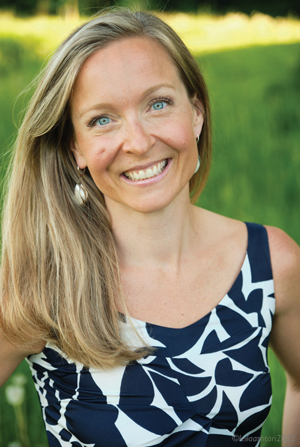
Dr. Jessica Riddell
IN CONVERSATION WITH DR. JESSICA RIDDELL
I interviewed Dr. Riddell in an effort to better understand how the pandemic had impacted the way we learn. I was intrigued by some of Dr. Riddell’s statements. In 2020, she wrote an opinion in University Affairs entitled: “A time for reflection. How do we make sense of what has happened, and how do we move forward towards a post-COVID world?” And more recently she made the following comment: “So as we reflect on the stories we have told and the new narratives we deploy to make sense of a seemingly senseless world, my hope is that we can pause, reflect and replenish before moving into the post-COVID world that awaits us.”
In our conversation, we further explored if COVID had had any impact on the way we learn. Dr. Riddell said that COVID had created a space to allow for transformation. In her opinion, COVID acted as a catalyst to help our reflection, stating examples such as Black Lives Matters. Dr. Riddell believes this pandemic brought to light a number of uncomfortable systemic social issues. We both agreed that this “social discomfort” had exposed truths and disrupting routines in our educational institutions.
I refer to this period in time as the “Great Awakening” and Dr. Riddell refers to this period in time as a “radical reset”. Whatever we may call this moment in history, Dr. Riddell claims the portal of the pandemic is closing which creates a sense of urgency. This is crucial as we consider what “learning” looks like today, post-COVID era, and what it could look like in the years to come.
A Framework in Flux
When I met Dr. Riddell, I wanted to better understand her desire to create a framework, to build resilient systems that can change our perspective on how we learn or unlearn as individuals. According to her, we must not talk about resilience at the individual level but rather put in place systems, structures and policies necessary to foster human flourishing. In all of her endeavours Dr. Riddell seeks to build communities with a commitment to support established and emerging learners and scholars in the pursuit of knowledge creation and sharing.
When we talked about how learning occurs, Dr. Riddell pointed out that universities are not always designed to collaborate, but rather they are designed to compete. According to Dr. Riddell, early adopters and innovators often experience discomfort; however, collaboration can address this discomfort and enhance positive change. Her statement caused me to reflect on our learning process as a whole, for individuals and institutions. When I asked Dr. Riddell, how do we then start to change the “way we learn”, she offered a very simple metaphor to my question. She said, “instead of thinking about how the pie must be divided, you need to bake new pies”.
An Incubator for Learning
According to Dr. Riddell, the Maple League of Universities are microcosms of larger institutions, they are just scaled differently. They all have deep culture, particular mindsets, systems, behaviour, and policies that have share common features. The benefit of COVID is that it made a number of things visible that were otherwise “hidden”. We now have to decide if the current educational institutions’ systems, structures and policies still serve our students and communities. We must answer this question: Are the higher education institutions built in the 19th century still relevant in the 21st century?
Dr. Riddell believes that by making systems or policies visible, you can invite a healthy conversation with a critical reflection to honestly assess if/where there is “discomfort”.
According to Dr. Riddell, this discomfort can lead to transformation. Using summits, workshops, classrooms and focus groups, Dr. Riddell is currently attempting to provide a forum for thoughtful, scholarly approach to multi-faceted issues by engaging across institutional boundaries with one goal in mind – to build more hopeful and resilient systems within higher education.
Dr. Riddell also referenced Parker Palmer, a Quaker philosopher whose works in higher education described fundamental change as being “broken open”. Being “broken open” means you are willing to transform. Dr. Riddell stated that in this post-pandemic moment, all the conditions are currently in place for us to be courageous enough and safe enough to be “broken open” — to challenge risk aversion situations and re-visit our institutional structures and policies.
The Hope University
According to Dr. Riddell, the condition for transformation to occur is discomfort. We both agree that to snap back to the status quo, back to business as usual is not the solution. The exposed truths and disruptions in our routines have created a sense of urgency for us to look at “what was” and transform into “what could be”.
When exploring “how we learn”, Dr. Riddell referenced how at times, we use toxic positivity which according to her makes us look at everything while erasing the discomfort of our transformation by saying “everything will be OK”. This perspective, however, may not offer the possibility to critically reflect on a given “discomfort” that we are experiencing, which can lead to profound transformative change.
Dr. Riddell’s solution is the Hope University. She says, “One of the fundamental questions in all my work is how do we rewire our systems, how do we renew them, how do we understand how the structures, policies, and systems form places where we create belonging, where we are invited in, where we can flourish, and we can tap into or connect to our own purpose. That, according to Dr. Riddell, is a fundamental question and an entry point into discussions about Hope University.”
Just last month Dr. Riddell was in Manchester, UK launching the EuroSoTL 2022 (International Society for the Scholarship of Teaching and Learning) where she delivered the keynote at the conference centered on Hope University. She was showcasing how Hope University as a concept without borders, can be built around fostering communities’ purposeful connections and creating moments where individuals can build their skills while still being in service to others.
My Final Thoughts
An interview with Dr. Riddell is like absorbing a massif flow of positive energy that pulls you into a new direction. She reminded me that we are all on a learning journey that miraculously has been impacted by a global pandemic. This pandemic, in itself, is deeply uncomfortable and unsettling yet can contribute to transforming what was —to what can be.
As Dr. Riddell said: “if the portal created by COVID, to fundamentally transform as institutions, as individuals and as communities is closing, we all need to continue to take part and to facilitate public-facing activities and projects”. As professional fundraisers, we are experts at building relationships and can provide further forums of consultations on a number of social “discomforts” that have arisen during this pandemic.
If we use a critical reflective practice, that is to narrate our own learning journey and then listen with the intention to transform, it is possible to unlearn and then re-learn. Could this be what the Hope University proposes: a community of learning which is meant to amplify voices and decolonize our institutions and where academy is more equitable, diverse and inclusive?
Then we can all play an active role in this “Great Awakening”.
Kathleen A. Provost, CFRE is currently the Director, Campaign Initiatives at St. Francis Xavier University, in Antigonish, NS. She brings over 25 years of fundraising experience within the charitable sector. She has been a Certified Fundraising Executive (CFRE) since 2007, and a long-time member and volunteer for the Association of Fundraising Professionals (AFP). As a recognized leader, Kathleen has tailored presentations and workshops for French and English audiences at various events including AFP-Nova Scotia, AFP-Ottawa, AFP-National Congress, Coady International Institute and the Canadian Council for the Advancement of Education. Kathleen is a McGill University graduate and holds a Master, Adult Education from St. Francis Xavier University. She has received numerous recognitions during her career, including the Queen Elizabeth II Diamond Jubilee Medal for her contributions to the charitable sector and 2021 Fundraiser of the Year in Nova Scotia.. She writes this column exclusively for each issue of Foundation Magazine.

Related Posts


