


Planned Giving, Family Legacies and Memories
Donors play a pivotal role in the sustainability, growth, and excellence of universities and colleges, acting as crucial catalysts for development and progress in the academic world. Their importance cannot be overstressed, as they contribute significantly not only to the financial well-being of these institutions but also to their academic, cultural, and infrastructural advancements.
Financially, donors provide essential funds that support scholarships, faculty positions, and research initiatives. These contributions make higher education more accessible to a broader range of students, ensuring that financial constraints do not hinder talented individuals from pursuing their academic and professional goals. Scholarships and grants enable students from diverse backgrounds to afford tuition, books, and living expenses, fostering a more inclusive and diverse academic environment.
Beyond financial support, donors often contribute to the development of state-of-the-art facilities such as libraries, laboratories, and lecture halls. These facilities are instrumental in providing a conducive learning and research environment, equipped with the latest technology and resources. This not only enhances the quality of education but also attracts esteemed faculty and researchers to the institution, further elevating its reputation and academic standing.
Donors also play a vital role in the advancement of research. By funding specific research projects, endowing professorships, and establishing research centers, they enable universities and colleges to explore innovative ideas, address societal challenges, and contribute to the global body of knowledge. This research can lead to groundbreaking discoveries, patents, and technological advancements, reinforcing the institution’s role as a leader in innovation and progress.
Moreover, the involvement of alumni as donors fosters a sense of community and ongoing engagement with the institution. Alumni contributions reflect a commitment to give back and support the next generation, creating a virtuous cycle of philanthropy and mutual support within the academic community.
There is no denying donors are indispensable to the vitality and success of universities and colleges. Through their generosity and vision, they ensure that these institutions continue to serve as beacons of learning, research, and innovation, shaping the minds and futures of generations to come.
Let’s take a look at a few of their stories.
YORK UNIVERSITY: Schulich Receives $1 Million Commitment in Support of Centre for Customer Centricity
Schulich has received a new $1 million commitment from StarTech.com in support of the School’s Centre for Customer Centricity, a hub for the creation, application and dissemination of knowledge related to making organizations customer-centric.
The Centre was established in 2019 thanks to an initial $1 million gift, which was also provided by StarTech.com, a leading IT connectivity products manufacturer with a portfolio of over 3,700 products designed to meet the needs of IT professionals. Founded in London, Ontario in 1985, StarTech.com has grown to become a global company with operations in 26 countries across five continents.
The Centre assists organizations in implementing a customer-centric management philosophy and culture. The Centre also provides organizations with customized consulting projects involving extensive industry, competitor, and customer analysis, followed by insights and practical recommendations.
The consulting projects are carried out annually by teams of MBA students, and the students are coached and guided by Professor Ajay Sirsi, the Centre’s Director and an Associate Professor of Marketing. Since 2019, the Centre has provided 225 MBA students with experiential learning consulting projects that has benefited 30 companies.
“We’re very excited about the continued support provided by Paul Seed and StarTech.com for this unique Centre,” says Schulich Dean Detlev Zwick. “The Centre for Customer Centricity is providing invaluable, real-world learning for our MBA students as they help companies solve complex problems, boost their bottom line and grow their customer base.”
“I am grateful for the trust Paul Seed has put in me and the Schulich School of Business to honour his desire to share with companies and MBA students the customer-centric thinking that has made StarTech.com a leader in IT connectivity accessories,” says Ajay Sirsi, Director of the Centre. “The only centre of its kind in the world, the Centre for Customer Centricity will continue inspiring students and guiding organizations wanting to put the customer at the heart of their decision-making.”
“I am excited to continue to support the Centre for Customer Centricity at the Schulich School of Business,” says Paul Seed, CEO and Owner of StarTech.com. “Under the leadership of Professor Sirsi, the Centre provides research to companies and experiential education to MBA students focused on customer centricity. I believe, in my 38-plus years of being an entrepreneur, that all business decisions start with the customer to achieve success.”
Companies or organizations interested in participating in a consulting project with the Centre can contact Professor Ajay Sirsi at: asirsi@schulich.yorku.ca.
UNIVERSITY OF BRITISH COLUMBIA: The doctor is not in: How two donors are addressing the lack of physicians in rural BC
UBC alumni Dr. Colleen Froese and Wayne Brown want to give more medical students the chance to train in rural communities.
Rural medicine is in crisis—with not enough doctors living and working in rural and remote communities in BC. There are many reasons for this—ranging from a need for alternative government payment models for family physicians to make their practices financially viable, to a reluctance by medical graduates to work in unfamiliar rural settings after training in major urban centers.
While not having a magic–bullet fix for such a complex problem, UBC Alumni Dr. Colleen Froese, BSc’75/MD’82, and Wayne Brown, BCom’81, feel one crucial part of the solution is familiarity with rural communities — and the need for medical students to experience this firsthand before graduating.
To this end, through a blended gift — a future bequest of their estate plans, combined with current-day giving — they have established the Colleen Froese, MD and Wayne Brown Award in Rural Health. The award is for third and fourth-year MD students interested in practicing in a rural community — with preference given to students from underserved communities.
As an MD and psychiatrist, Colleen feels training in a rural setting makes for an easier transition rather than moving there after graduation. “Otherwise, if you haven’t experienced it, it’s difficult to make that transition once you finish your residency training.”
The need for more doctors in BC’s rural communities is something Colleen experienced firsthand.
“I grew up in the north and looked after my parents in Terrace, BC, when they were elderly. I realized the difficulties people face with medical care in the north are everywhere,” Colleen says. “While it’s not a simple solution — I think many graduating physicians simply haven’t experienced what it’s like to live in small towns or the north.”
Colleen feels that giving more medical students the chance to work in rural BC would change attitudes and have beneficial knock-on effects for community health.
“If they went even for a small part of their training, they might be enticed to go longer or do more and give back to these rural communities in BC.”
Wayne agrees. Having accompanied Colleen on trips to Terrace, where she provided psychiatric treatment for patients, Wayne saw the urgent need for more doctors outside BC’s urban centers.
“Listening to Colleen talk about the need for younger physicians servicing rural environments—I realize there’s currently no stability in terms of people staying and working there.”
For Colleen and Wayne, it’s about impressing upon the next generation of physicians the vital role doctors play by personally working in the community.
“I think it’s essential because even though there’s remote medicine,” says Wayne. “Having boots on the ground — where you have that face-to-face interaction with your patients — I think that’s important too.”
By making part of their gift now, to establish the award, Colleen and Wayne get to see the fruits of their philanthropy during their lifetime.
“Knowing your gift is doing something while you’re alive is a benefit,” says Wayne. “And not having children, we don’t have that expense — and we live fairly modestly — it made sense for us.”
The process of estate planning also meant peace of mind, knowing their wishes would be carried out as they hoped.
“I think the process has been wonderful,” says Colleen. “There has been lots of help getting our wishes down properly. And you need time for that process — so it’s good to start it as soon as you can.”
Reflecting on her numerous trips from Vancouver to her psychiatry practice in Terrace, Colleen is glad to continue supporting rural medical care with her and Wayne’s philanthropy.
“It’s been a great journey, and it’s nice to carry on something you care about — that you will never see if you leave it too late.”
McMASTER UNIVERSITY: ‘If You Build it, They CAN Come’: A Legacy of Accessibility Advocacy
By Michael Cordeiro
Barrier-free washrooms. Wheelchair ramps. Automated door openers. Voice annunciation and braille in campus elevators.
These are just a few of the accessibility improvements made throughout McMaster University over the past 35 years, thanks in part to the trailblazing leadership of the university’s former director of Student Accessibility Services (SAS), Tim Nolan, BA ’86, BSW ’04.
While Nolan retired in 2020, he and his wife Kim, BA/BSW ’04, MSW ’09, continue to enhance accessibility on campus and advocate for students through philanthropic giving.
For nearly a decade the couple has been committed to supporting students through charitable gifts. They established a bursary in 2014 in honour of Nolan’s parents. The Jeanne and Peter Nolan Award is awarded annually to students in a social work program registered with SAS.
In 2022, the Nolans established the first donor-funded bursary for graduate students registered with SAS: The Kim and Tim Nolan SAS Graduate Student Award. It is awarded by the School of Graduate Studies to students who demonstrate academic excellence, are enrolled in a Social Sciences program and registered with SAS. Preference is given to students in the social work program.
The Nolans also recently supported the Physical Activity Centre of Excellence (PACE) with a gift to purchase specialized exercise equipment to help break down physical and mental barriers. Kim regularly attends PACE and praises the centre for its dedication to accessibility.
They are also leaving a gift in their will to SAS and PACE.
“We simply hope to be a helping hand to others who live with a disability,” said Nolan.
“Kim and I have both benefited from the kindness of others, so we would like to give back, or pay it forward, so to speak.”
Kim echoed her husband’s sentiment and added, “giving back to McMaster gives hope to those with disabilities that they can make a good life for themselves, just like we have.”
The need for accessibility
Nolan was hired in 1988 as the university’s first program coordinator to facilitate academic accommodations for students with disabilities. Having lost most of his eyesight due to diabetes, he wanted to use his lived experience to help others with disabilities.
“I learned quickly from students and faculty that they wanted accommodation through accessibility,” said Nolan.
“In addition to academic accommodations, I knew I needed to help create a more accessible campus.”
At the time, the university wasn’t fully accessible to those with physical disabilities. Nolan recalled several stories of students who had to overcome barriers, including a student who was carried up and down the stairs in his motorized wheelchair by his peers, and another who had to ride a freight elevator to reach the dining room in the Commons Building.
“These stories didn’t sit well with me,” he said. “I began working closely with Facility Services (then called Physical Plant) to find solutions to these barriers students faced.”
One such student was Nolan’s future wife, Kim.
Kim lives with multiple sclerosis and requires the use of a wheelchair. She first attended McMaster in 1993, when there was only one accessible washroom on campus.
“I couldn’t get to that one accessible washroom on my own, so it made going to school a challenge,” said Kim. “When I met Tim, he acknowledged there was an accessibility issue on campus and it inspired me to also want to help improve the university.”
Advocating for change
The couple made it their personal mission to bolster accessibility at McMaster and in the community.
Some of the challenges Nolan faced ranged from insufficient funding for accessibility upgrades to a lack of awareness from colleagues. Despite these challenges, he continued his fight to make campus more accessible and educate others on the importance of accommodation.
“There were countless discussions with personnel from the university,” he explained. “I spoke with contractors, architects, the person who draws the campus maps, project managers, directors. I arranged sessions with the Ontario Human Rights Commission to meet with the president and vice-presidents so leadership could learn about the university’s obligation to creating an accommodating environment.”
Many of the fundamental services and amenities we take for granted today were led in partnership with Nolan. He was instrumental in securing accessible computer equipment so students can access coursework, installing wheelchair lifts, ramps and elevators, and undertaking a multi-year project to build wheelchair-friendly washrooms in every building on campus, among other projects.
Meanwhile, Kim began supporting students after she graduated in 2004 from the combined bachelor of arts/bachelor of social work program, working as an academic assistant in the gerontology program (now called Health, Aging & Society).
“I helped first year gerontology students secure a 10-hour placement, which was one of the requirements for the course at the time,” she said. “I also helped with a web-based, non-credit course that supported fourth-year students with professional development.”
Kim continued to work as an academic assistant while enrolled in the master of social work program, and was hired as a career transition coordinator and disability specialist with Career Services after she graduated in 2009.
During her tenure, she oversaw the delivery of disability-related education and academic accommodations, support and counselling services, and career development programming to students with a wide range of disabilities.
“My goal was to help students with disabilities find meaningful employment aligned with their academic interests and career goals.”

Tim Nolan, the former director of Student Accessibility Services (SAS) who worked at McMaster from 1988 until his retirement in 2020, alongside his wife and fellow accessibility advocate, Kim Nolan. In August 2022, the SAS testing centre was renamed the Tim Nolan Testing Centre in recognition of Nolan’s longstanding advocacy for accessibility and accommodation on campus.
The impact of accessibility
In recognition of Nolan’s pioneering advocacy, the SAS testing centre was renamed the Tim Nolan Testing Centre in August 2022. Located in the McMaster University Student Centre basement, the testing centre provides accommodations for students who require support for exams.
“When they phoned Tim to tell him they were naming the centre in his honour, it was the first time he’s ever been speechless,” recalled Kim.
“It was almost surreal,” added Nolan. “I don’t know how else to describe this honour.”
Now enjoying their retirement, the couple continues to be engaged with McMaster and support a variety of disability-related causes in the community.
Kim volunteers with the McMaster Collaborative for Health and Aging as an older adult and caregiver member to ensure the needs, perspectives and aspirations of older adults are reflected in the collaborative’s work. Likewise, she is active in supporting the educational journeys of students in the Health, Aging & Society Program.
“When I was an academic assistant in the gerontology program, I ran a program where I would bring in seniors from the community to run tutorials for first-year students,” Kim said. “Now, after all these years, we’re volunteering for the program as seniors. It’s funny how it has come full circle.”
As Nolan reflected on his own legacy at McMaster, he encapsulates the impact of accessibility on campus by putting his own spin on a famous movie line from the 1989 film Field of Dreams.
“Instead of ‘If you build it, they will come,’ I believe ‘If you build it, they can come.’ By creating a more accessible campus, students of all abilities can attend and thrive at McMaster.”
Why McMaster donors give: At McMaster University, every single gift, no matter the size, has the potential to make a difference in the lives of our students, the quality of our research and our ability to give back to our community and influence the future. We asked some of our donors and their families what motivates them to give. These are their stories.
This article was first published on McMaster’s Daily News.
UNIVERSITY OF ALBERTA: Donors Provide a Vital $10M to Defeating Diabetes Campaign
By Erik Einsiedel
Melanie Hibbard and Lindsay Burnham both know what it’s like to be part of a family affected by diabetes. Hibbard’s two sons were diagnosed with Type 1 diabetes, and Burnham lost her sister to the disease.
But both also know first-hand how close the University of Alberta is to finding a cure. Their experience comes from Hibbard’s role as executive director of the Diabetes Research Institute Foundation Canada (DRIFCan), and Burnham’s as executive director of the Alberta Diabetes Foundation (ADF). Both organizations have been longtime supporters of the U of A for more than 20 years. The partnership fosters collaboration, inspired by community leaders and donors, to see organizations with a common purpose come together with one goal: defeat diabetes.
This partnership made a $10-million fundraising initiative possible for U of A diabetes research. The Defeating Diabetes campaign launched in 2020, and now, three years later, the U of A marked World Diabetes Day 2023 by announcing that 80 per cent of that $10-million goal has now been raised.
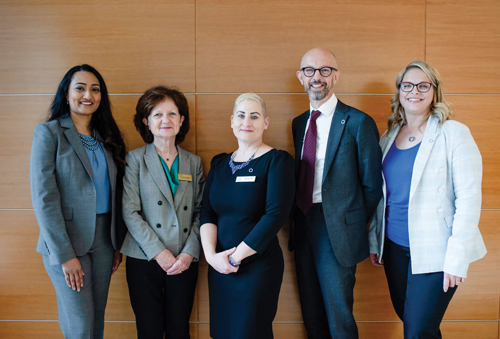
Left to right: Angelina Bakshi, Board Chair, Alberta Diabetes Foundation; Brenda Hemmelgarn, Dean, Faculty of Medicine & Dentistry; Lindsay Burnham, Executive Director, Alberta Diabetes Foundation; Peter Senior, Director, Alberta Diabetes Institute; Melanie Hibbard, Executive Director, Diabetes Research Institute Foundation Canada (Photo credit: Laughing Dog Photography)
Thanks to the support of DRIFCan, ADF and their communities of donors, Defeating Diabetes has helped advance groundbreaking research projects at the Alberta Diabetes Institute (ADI), Canada’s largest stand-alone research facility at the University of Alberta dedicated to preventing, treating and curing diabetes.
Opened in 2007, ADI is the manifestation of the U of A’s longstanding pursuit of that cure. It is a legacy of research stretching back to the 1920s with James Collip, then head of the Department of Biochemistry, who is co-credited with the discovery of insulin. Today, ADI researchers have made life-changing advances of their own, continuing in Collip’s footsteps a hundred years later.
These advances include the work of ADI researcher Jean Buteau and his team, who have identified a specific gene in insulin-producing cells, a step toward creating a new class of medications for treating diabetes. Now ready for the first clinical trial in humans, this could be one of the most significant diabetes breakthroughs to date, with potential for improved glucose control, reduced insulin dependency and even diabetes remission.
ADI is also home to James Shapiro and his team responsible for the Edmonton Protocol, the world’s largest islet transplant program, which helps people with Type 1 diabetes gain freedom from insulin injections. This program has successfully improved quality of life for hundreds of people with hard-to-control diabetes over the last 20 years.
Hibbard recalls meeting Shapiro in 2015, and was inspired to apply the full force of DRIFCan toward directly funding his team in their pursuit of a cure.
“As a mother of two children with Type 1 diabetes, I see first-hand the effect this disease has on our community, our health-care system and most importantly, my own family,” says Hibbard. “For the last 20 years, I have had the privilege of supporting cure-based research and together, with DRIFCan’s community of donors, we are providing hope for a cure for families like mine.”
For Burnham, it was heartbreaking to watch her sister struggle to do the things people her age are excited about, like graduating from high school, learning to drive or heading off to college. Burnham and her family witnessed her sister’s struggles with managing her diabetes — the countless appointments, hospital stays, medications and missed opportunities.
Like Hibbard, Burnham has deep personal motivations to see this disease cured, so no child will ever have to experience what her sister did. The Defeating Diabetes campaign was the perfect opportunity for Burnham and ADF to collaborate with other organizations like DRIFCan, united in their common pursuit of a diabetes cure for the world.
“Since that first islet transplant in 1989, the Alberta Diabetes Foundation has been proud to support the work happening right here in Edmonton,” says Burnham. “The global reach of the research happening at the Alberta Diabetes Institute is amazing — something all Albertans should be proud of. Having the opportunity to collaborate with other funding partners demonstrates our mandate: working together to find a cure.”
Buteau and Shapiro are just two of the many dedicated ADI researchers whose mission to defeat diabetes is made possible by the generosity of DRIFCan, ADF and other donors in support of the Defeating Diabetes campaign. Their work offers hope to more than 1.2 million Albertans living with diabetes, and they credit their success to the vital community and philanthropic support that brings this life-changing research to fruition.
The Defeating Diabetes campaign also supports several other U of A researchers, including Greg Korbutt and Andrew Pepper, who are addressing the supply issue of islets for transplant, and Andrea Haqq, who is exploring therapies to prevent Type 2 diabetes in children.
UNIVERSITY OF TORONTO: Beatrice and Arthur Minden Foundation
The Beatrice and Arthur Minden Foundation establishes a Symposium on the Environment and a Graduate Research Fellowship. U of T’s School of the Environment has received a huge boost to its educational and research capacities thanks to the vision and generosity of the Beatrice and Arthur Minden Foundation in establishing the Beatrice and Arthur Minden Symposium on the Environment and the Beatrice and Arthur Minden Graduate Research Fellowship.
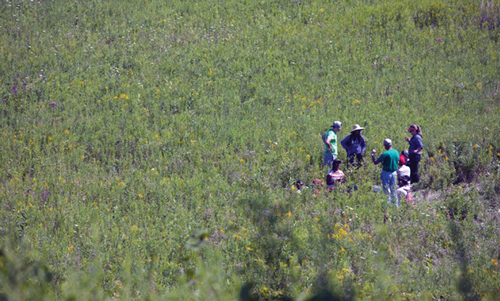
The symposium will enable the School of the Environment to bring together international researchers and cross-disciplinary scholars on an annual basis to discuss and debate the most urgent environmental issues. “We hope that this annual event will catalyze meaningful new collaborations on key environmental issues, leading to new ideas and insights, proposals for workable solutions and plans for future interactions,” says the school’s director, Kimberly Strong.
The graduate research fellowship, meanwhile, will support PhD students by enabling their participation in conferences, summer schools, fieldwork and collaborative visits to research groups across Canada and around the world. “These fellowships are intended to make a real difference to our students,” Strong says, “giving them new opportunities to expand and strengthen their research on environmental issues.”
The Beatrice and Arthur Minden Foundation was established by Beatrice Minden in honour of her late husband, Arthur, a lawyer and philanthropist who co-founded the Muscular Dystrophy Association of Canada in 1954.
Arthur came to Canada from Zhitomir, then part of the Russian Empire, with his family in 1912 at the age of two. The first in his family to go to university, Arthur attended the University of Toronto (BA 1932) and Osgoode Hall before setting up his law practice. Well-known for his enthusiasm, good spirit and generous character, he was heavily involved in the community, and in Toronto’s arts and Jewish communities, in particular. Following his death in 1966, Beatrice set out to continue his philanthropic work and legacy through the foundation, which has supported a range of activities, from university scholarships in Israel to cultural events and hospitals in Toronto.
After Beatrice passed away in 2009, their children, George, Robert, Jo-Ann and Cynthia continued the work of the foundation. In each of the four years since their mother’s death, the siblings took turns deciding which activities the foundation would support, after which time they decided to find a single cause to support. Earlier this year, they settled on the School of the Environment.
“We wanted to find a home for the foundation, a way to honour our parents, their spirit and their legacy. We were all excited about the new School of the Environment at U of T and felt this was a great fit: the city in which our parents spent their lives, the university that so inspired our father and the potential to develop cutting-edge solutions to some of the most pressing problems humanity is facing regarding climate change,” says Cynthia, whose three siblings attended U of T. “My parents had a passion for education, and my father had a tremendous appreciation for how U of T altered the course of his life in such a profound and significant way. It was pivotal for him to go to U of T and he was always grateful for that opportunity.”
Cynthia says that she and her brothers and sister all feel very strongly about supporting solutions to ecological problems. A longtime resident of Denman Island, British Columbia, she’s been a concerned citizen who has protested clear-cut logging in Clayoquot Sound and other local causes that spotlight the exploitation of natural resources. “Environmental studies are something that we all support and it is important to us to direct the foundation’s capital to where it would have the greatest impact. I think we’ve found that at U of T.”
The School of the Environment was established in 2012 to leverage the enormous breadth and depth of environmental teaching and research expertise within U of T’s Faculty of Arts & Science. The school offers undergraduate programs in environmental studies and environment and science. The school also partners with other departments and programs at U of T to offer a range of collaborative undergraduate specialists, majors and minors, involving chemistry, geography, earth sciences, human biology, physics, philosophy and others. At the graduate level, interdisciplinary collaborative programs in environmental studies, as well as in environment and health, are offered in partnership with 20 other units at the University, with other new programs in development.
“We love the idea of supporting new and ongoing research and teaching in this area, especially given the alarming issue of climate change,” Cynthia says. “And I’m pretty sure my parents would feel that it’s an important cause, as well.
UNIVERSITY OF TORONTO St. GEORGE CAMPUS: Amir Hussain’s memorial gift becomes a lasting legacy
Growing up in Toronto’s Parkdale neighbourhood, Amir Hussain never considered academia as a career path. But from the day he first set foot on U of T’s St. George campus, he was hooked. “I fell in love with the place,” he says of his days at University College. After completing an undergraduate degree in psychology at U of T in 1987, Prof. Hussain went on to a master’s and PhD in religious studies. Today, he is a professor of theological studies at Loyola Marymount University in Los Angeles.
In 1987, Prof. Hussain met Shannon Hamm, a fellow don at the Sir Daniel Wilson residence and psychology doctoral student. They married in 1989. But tragedy struck the young couple in the summer of 1992 when Shannon passed away suddenly from a pulmonary embolism. “You learn from that — life can throw you into unexpected circumstances,” says Prof. Hussain.
After Shannon passed away, Prof. Hussain wanted to ensure that he made provisions to recognize who she was. Using some of the proceeds of her life insurance, Prof. Hussain set up the Shannon L. Hamm Award in Peace and Conflict Studies (he also set up scholarships in her name at the University of Manitoba as well as the two Los Angeles institutions where he would go on to work). “It was important to me to do something in Toronto to honour her. That little bit of life insurance provided the means.”
Prof. Hussain has continued to donate to the U of T scholarship since that time. After living in the U.S. for several years, Prof. Hussain was approached by U of T Gift Planning staff to consider setting up a bequest that could augment the scholarship he created. At first, he thought the idea was “ridiculous” — he thought that bequests are set up by only wealthy individuals. But staff explained the many other ways to create legacy gifts. “I thought that as much as I would love to be able to give back a large sum of money to U of T, I don’t have those means. The gift planning staff asked if I had considered donating a small Canadian RRSP fund. Since I don’t plan to come back to Toronto to retire, this made sense.”
He has named U of T the beneficiary of the RRSP and an additional Canadian life insurance policy.
Prof. Hussain knows well the value of legacy gifts. As a student, he himself received a scholarship set up by a donor who had passed away long before Prof. Hussain arrived at U of T that fall of 1983. “I’m happy that I can recognize Shannon and the person she was by leaving a legacy to this place that was so important to us.”

Related Posts


