


Vital Signs Report Meets Campaign
From the Editors of Foundation Magazine. Adapted from the 2023 Toronto’s Vital Signs Report: The Power of Us.
The conversation around Toronto’s Vital Signs Report has always served as a key monitor for the city’s heartbeat, but this year is different. What we learned from last year’s second-ever Social Capital Study is that strong social connections and trust go hand-in-hand with people’s wellbeing. So we narrowed our scope of data to focus on our shared predicament and put social connections, mental health and the state of our public realm at the core of every chapter. It’s a departure from the norm, but we feel it’s an essential one for the times. We’re also doubling down on action. While we can’t change what the data reveals, we want to use this report to influence a better future through a collective campaign rooted in action. We know that a shared commitment to our collective wellbeing is the only way forward.
As with past reports, we continue to rely on disaggregated data to demonstrate the role of inequity in our understanding of the 10 issue areas we track. This is coupled with perspectives from a diversity of city leaders who helped inform our analysis and whose voices are featured throughout the report. However, by approaching this report through the lens of social capital, you’ll find some historical metrics that are quintessential to Vital Signs are absent. Rest assured, many of the traditional indicators will be reincorporated in future editions, ensuring that our portrayal of the state of Toronto remains holistic and nuanced over time.
“Giving up on this place we call home is also a non-starter. It’s time to get involved, take a stand, reignite your love for Toronto.” Sharon Avery, President and CEO, Toronto Foundation and Fundholder, Avery Family Foundation.
By some estimates, more than 70,000 Indigenous people call Toronto home although there has long been systemic barriers to accurate data collection, including the “lack of culturally-based, Indigenous-led and specific measures and health information systems that prevent and exclude Indigenous people from governing, managing, and leading their own research and data processes,” as described in Well Living House’s Our Health Counts Toronto study. As a result, we acknowledge this report leaves crucial gaps in our understanding of that community and look to organizations like the Toronto Aboriginal Support Services Council and its research to further ground our findings.
In this distinct edition, we’ve delved into a vast data pool, while also relying heavily on the 2018 and the 2022 Toronto Social Capital Study. These data sets, conducted pre- and post-pandemic, include some critical metrics on the most important facets of life in the city. Together, they illuminate the shifting experiences of Torontonians related to relationships, trust, wellbeing and more. As we offer insights into late 2023, we’ve taken great care to incorporate the most current data from dozens of partners, providing clarity on Toronto’s current state, while offering glimpses into its potential futures.
So, let’s take a look at the major findings of the 2023 Vital Signs Report. There are ten major categories by which we examine the city’s vital signs.
Civic Engagement
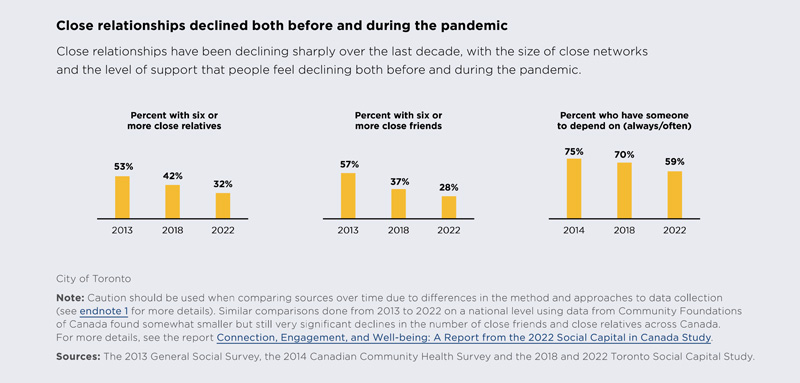
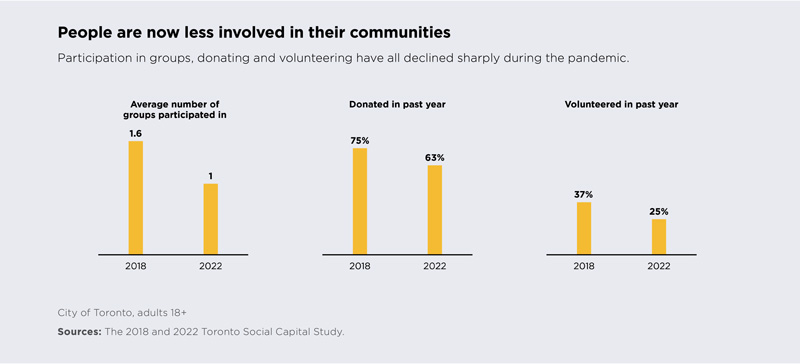
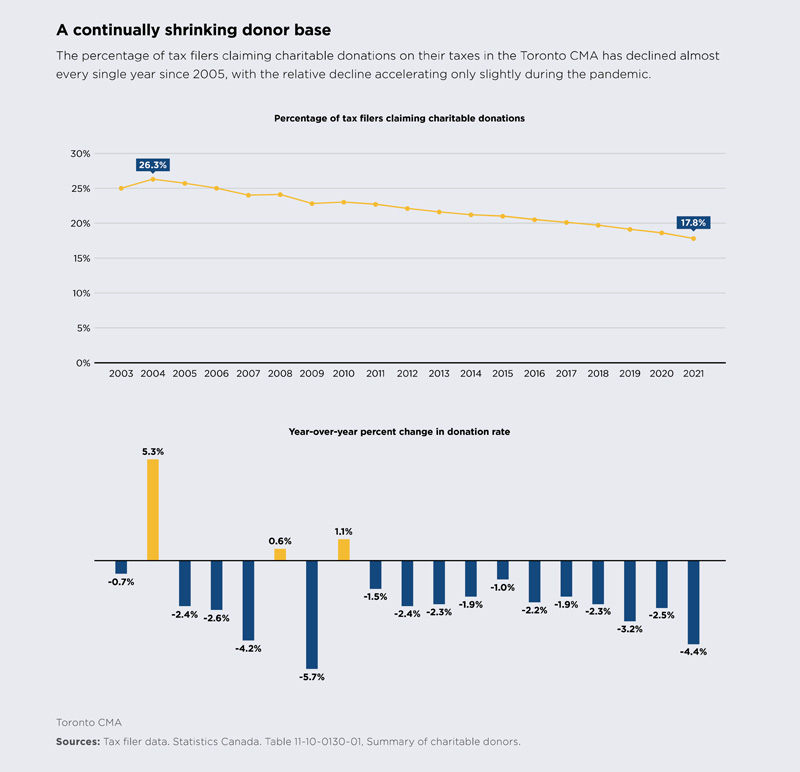
Since the pandemic, Toronto residents interact and volunteer less, continuing at least a decade-long decline in donations and social ties, putting increasing strain on our social fabric and nonprofit sector.
- The percentage of people with six or more close friends declined by 20 percentage points from 2013 to 2018 and a further nine points from 2018 to 2022.
- Similarly, the percentage of Toronto residents with six or more close relatives dropped by 11 percentage points from 2013 to 2018 and another 10 points from 2018 to 2022.
- The volunteer rate fell from 37 percent to 25 percent between 2018 and 2022, while the donation rate slipped from 75 percent to 63 percent, leading to a loss of about 300,000 donors and 300,0000 volunteers.
- Confidence levels in most local institutions has remained mostly unchanged since before the pandemic, with neighbourhood centres becoming the most trusted institution, as trust in the police declined.
Nothing defines our city more than the collection of its 158 neighbourhoods. Each one has its own identity formed by the people who live there. The strength of our local relationships plays a big part in our sense of belonging. Let’s deepen the ties that connect us to our neighbours.
- Lend a hand to someone nearby who needs it.
- Join a neighbourhood group or start one up.
- Reconnect with a friend or neighbour.
- More than a city of neighbourhoods let’s become a city of neighbours.
Our goals are to increase donation rates to nonprofits, increase volunteering across neighboourhoods and increase the size of social networks.
Health
The mental health of Toronto residents, many of whom feel socially isolated, has not improved over the past couple of years, after rapid deterioration during the pandemic, despite the lifting of pandemic restrictions.
- A full 23 percent of Toronto’s adult population, about 575,000 people, reported symptoms consistent with a major depressive disorder in the second quarter of 2023, showing next to no improvement versus earlier in the pandemic.
- And this prevalence is especially pronounced among young women, those who are socially isolated and financially vulnerable groups.
- By mid-2023, about 19 percent of the adult population, roughly 475,000 people, showed symptoms consistent with generalized anxiety disorder.
- Toronto is one of the loneliest places in the country. About 925,000 adults in Toronto (37 percent) felt lonely on at least three or four days in the last week in 2023 — higher than the rest of the country (28 percent), other major regions and other major cities.
Loneliness is increasingly recognized as one of the most serious risk factors of many negative health outcomes. For many groups, loneliness is a daily reality and social isolation is a factor in the acute declines in mental health in the population at large too. Think about checking in on a work colleague who may be absent; send a meal to a friend going through a tough time; or support organizations serving the disability community, which forms a growing part of our society and faces some of the steepest challenges.
More than a third of the city’s population, around 36 percent, about 900,000 adults, have a mental or physical health condition that occasionally impacts their daily activities and those with a disability are twice as likely to score high on our discrimination index as the general population.
Our goals are to decrease the rates of loneliness and depression, increase disability supports and add to the resources for mental health.
Learning
Despite the increased mental health challenges and social isolation among teenaged students, graduation rates have increased, and more students are attending post-secondary institutions, even as learning loss lingers as a major issue.
- In 2021, 38 percent of teenaged students in Ontario reported fair or poor mental health, up from 27 percent in 2019.
- Female students in grades 7 to 12 were significantly more likely than their male counterparts to report poor mental health, elevated stress and serious psychological distress. The rate of psychiatric emergency department visits for young girls aged 13 to 17 in Ontario increased by 125 percent between 2009–2017.
- Loneliness among Toronto District School Board (TDSB) secondary students has doubled, with 44 percent feeling frequently lonely in 2021, mirroring a global trend of high school student loneliness that’s been escalating even pre-pandemic.
- The pandemic has resulted in learning loss, particularly in younger TDSB students and in mathematics. But graduation rates are higher, and more students are going on to post-secondary education, with the biggest improvements among Black and Indigenous students.
Schools are places of academic and vocational advancement, and they are also communities of young people under the guidance of caring adults. Young people need to know there is a larger support system out there that cares about them. That they are not alone.
- Donate to local nonprofts that offer peer-to-peer programs and those that bridge the divide between school and work.
- Advocate for greater access to free mental health supports for children and youth.
- If you’re a caregiver to a school-aged kid, befriend fellow caregivers you don’t yet know. Despite the increased mental health challenges and social isolation among teenaged students, graduation rates have increased, and more students are attending post-secondary institutions, even as learning loss lingers as a major issue.
Our goals are to decrease psychiatric emergency department visits for teens, increase in-school mental health supports and increase investments in career mentorship programs.
Arts, Culture & Recreation
Participation in arts, culture and recreation has dropped significantly since the pandemic, and data suggests that lower rates of participation have continued at critical institutions well into 2023.
- Participation in cultural, educational and hobby organizations was down 39 percent between 2018 and 2022, and sports and recreational organizations saw a 30 percent decline over the same time period, but several outdoor arts events showed better than pre-pandemic attendance during summer 2023.
- The reduction in participation has been particularly notable among residents aged 55 years and older, women (for sports and recreational activities) and those with high household incomes. Racial disparities have also been observed, with the greatest decline among white and Black Torontonians.
- Frequent usage of community assets and public spaces correlates strongly with better mental health, stronger social connections, a higher sense of belonging and increased rates of donations and volunteering.
- Parts of Toronto, particularly outlying areas, have significantly lower access to recreational facilities and community services.
Arts, culture and recreation are often the bridge to bring communities together. But participation remains down overall and inaccessible for many. This is how we share and celebrate our stories and experiences, and test and challenge the boundaries of what it means to be human.
- Support sports and cultural organizations that offer free or subsidized opportunities for low-income and otherwise marginalized communities.
- Advocate for local and culturally relevant programming, especially in underserved areas.
- Check out a new local event or performance.
Our goals are to increase youth participation in sports and recreation, increase audiences for indoor arts events and increase rates of life satisfaction.
Environment
Access to Toronto parks and their related infrastructure remains unequal, meaning that not all residents benefit from the city’s natural air-filtering and cooling system and the relief that parks provide on the increasing number of sweltering summer days.
- Toronto boasts more than 1,500 parks and a 28 percent tree canopy, but 43 percent of residents, primarily in lower-income and racialized areas, grapple with scarce greenery.
- Most residents (92 percent) can walk to parks, but park usage varies across the city, due to the functionality, facilities and programming offered in these spaces.
- Residents of Emerging Neighbourhoods* were particularly less likely than other neighbourhoods to feel their neighbourhoods had safe places for children to play and were less likely to visit local parks.
- Cycling’s popularity surged due to enhanced infrastructure, but suburban areas are still lagging. Bike Share Toronto trips notably jumped from 2.5 million in 2019 to 4.5 million in 2022.
Toronto is rich in natural assets with a Great Lake, a rare urban tree canopy and a diverse ravine ecosystem that runs across the entire city. Yet how green your neighbourhood is, the safety of your park, or how much time you spend outside shouldn’t come down to where you can afford to live. Urban nature is part of the public realm; it is all of ours to enjoy and benefit from.
- Realize your citizen power and organize for nature.
- Join a park friends group or start up one.
- Advocate for more Bike Share stations.
Note: *”Emerging Neighbourhoods” is an official designation by the City of Toronto to identify neighbourhoods that previously had high levels of inequality but not listed as a “Neighbourhood Improvement Area.
Our goals are to increase investments in park facilities and tree coverage in low-income, racialized neighbourhoods, increase bike infrastructure projects beyond downtown to suburbs, and increase rates of mental health benefits.
We have the citizen power to organize for nature.

Work
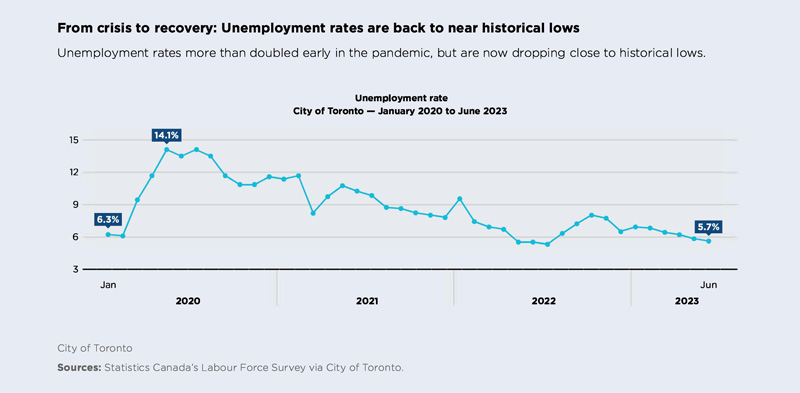
Employment has rebounded post-pandemic but Torontonians are feeling burnt out and precarious in their work while increased hybrid arrangements have led to the hollowing out of downtown offices.
- In June 2023, Toronto’s unemployment rate had dropped to 5.7 percent, employment was up 16 percent and average hourly wages had risen by 19 percent, compared to February 2020.
- Despite near historically low unemployment, financial struggles persist, with 33 percent of city of Toronto residents stating their household income was insufficient in 2023 (up from 21 percent in 2018). At the same time, more than half of Toronto CMA* residents fear for their or their family member’s ability to keep or find a stable full-time job (15 points higher than the rest of country). Additionally, 33 percent worry their job may be automated in the future.
- Hybrid work arrangements doubled from 14 percent in 2021 to 28 percent in 2023 across the Toronto CMA, contributing to downtown Toronto offices having only 52 percent of pre-pandemic occupancy levels by July 2023.
- More than one in five (22 percent) of workers in the city of Toronto often feel exhausted or burnt out, with an additional 42 percent experiencing these feelings occasionally.
The rise in remote work has led to the workplace being in a state of flux. The social implications of these shifts are huge with growing job precarity, loneliness and high stress.
- If you’re an employer consider what you can do to bring workers together for mutual support.
- If you’re a hybrid worker, consider showing up at the office more often.
- Advocate for better work conditions by supporting local organizing for fair salaries, job security and benefits.
Note: *Census Metropolitan Area (CMA) is formed by adjacent municipalities connected to a population centre. Toronto’s CMA extends from Oakville to Ajax and up to Bradford West Gwillimbury to the north.
Our goals are to increase the number of employers offering a living wage, decrease the rates of burnout and increase in-person connections at work.
How we work is a demonstration of our shared values.
Getting Around
Public transit, a critical link that connects Torontonians, faces dwindling ridership and service cuts while fewer people are returning to downtown than most other major North American cities.
- The pandemic has significantly reduced Toronto’s transit ridership, with the Toronto Transit Commission (TTC) weekday ridership at 72 percent and GO Transit at 69 percent of pre-pandemic levels by mid-2023. The shift to a hybrid work trend suggests this might persist.
- Financial challenges and insufficient government funding have prompted TTC cuts, especially affecting bus routes in lower-income areas that are vital for essential workers and marginalized groups.
- Offences against passengers on the TTC have soared, with rates rising from 1.3 offences per million rides in 2019 to consistently above 3.2 offences per million rides since the beginning of the pandemic.
- Downtown Toronto’s foot traffic in early 2023 is below half of its pre-pandemic level, and this recovery trails most other North American cities, possibly due in part to the city’s long work commutes.
Efficient, reliable public transit is essential. In a city of three million no one debates that. But getting there remains elusive. As one of the most heavily user-supported systems in the world, when ridership drops as it has, the financial model completely breaks down. And community safety depends on all of us showing up too.
- Support downtown businesses by attending events and visiting shops.
- Advocate for shared, sustainable funding across all levels of government.
- Opt for transit a little more often than you do now.
Our goals are to increase public transit ridership, increase the rates of transit safety and to increase downtown foot traffic.
High-quality public transportation is the best way to keep us connected.
Safety
Despite a recent uptick in the crime rate, Toronto remains one of the safest cities in the country, and yet certain groups face regular discrimination and feel less safe.
- Major crime in Toronto rose 4 percent in 2022, compared to 2019, and an additional 20 percent in the first half of 2023, compared to the first half of 2022, with auto thefts driving the increase and assaults also increasing, even as homicide rates are lower.
- Despite this, Toronto CMA’s 2022 Crime Severity Index ranked second lowest among large CMAs and it has decreased by about half since 1998.
- 2SLGBTQ+, younger, racialized and economically-disadvantaged residents often feel less safe due to experiences of discrimination.
- A full 27 percent of Toronto adults, roughly 675,000 people, experience high discrimination—roughly translating to experiencing multiple forms of discrimination per week. People with mental health–related disabilities are most likely to experience at least moderate levels of discrimination (68 percent) and they are also the group who feels the least safe in the city.
We all deserve to feel safe. And yet no group in the city feels less safe than those with mental health disabilities. What’s more, an alarming number of residents experience multiple forms of discrimination every week. Community safety starts with empathy and shared accountability.
- Seek out moments to connect with strangers, especially those who are different than you.
- Learn how to support those experiencing a mental health crisis.
- Support drop-ins and other front-line organizations serving the most vulnerable.
Our goals are to decrease levels of everyday discrimination, increase feelings and experience of safety and decrease the rate of deaths from drug toxicity.
We all have a role to play in keeping Toronto safe.
Housing
Toronto’s escalating housing crisis not only threatens individual health and wellbeing, but it also erodes the city’s social fabric.
- Houses in the Toronto CMA cost about 9.5 times the median income, far surpassing the threshold of severe unaffordability. The hourly minimum wage would need to rise to $33.60 — more than double its current level — for a single minimum wage worker to afford an average one-bedroom apartment.
- Although Toronto’s population continues to grow, there has been a significant net increase in people leaving the city for other Canadian provinces or cities, especially among those aged 15 to 44 years of age.
- Overcrowding in Toronto is a growing concern, with 17 percent of people in the Toronto CMA living in overcrowded conditions, including almost a third of newcomers (32 percent).
- Toronto has more multi-generational households than anywhere else in the country, but the growth rate of these households lags the Canadian average and is well below nearby areas in Ontario such as Oshawa, Barrie, St. Catharines and the Waterloo Region.
- In 2018, there was one formal eviction application for every 20 renter households (5 percent) and in some neighbourhoods, there was one eviction fling for every five renter households. Areas with the highest number of Black home renters had twice the eviction rates as areas with the lowest number of Black home renters, even after controlling for poverty and other factors.
Housing is a human right. All three levels of government say so. And yet we continue to tolerate people living amongst us without the dignity and security of a permanent home.
- Donate to organizations tackling this issue, driven by people with lived experience of homelessness.
- Advocate for a return to investment in new public housing.
- Support nonproft housing solutions near you so that decision-making and real estate wealth creation can be in community hands.
Our goals are to decrease the rate of evictions, increase development of non-market and nonproft housing units and to decrease rates of overcrowded households.
It’s time to be intolerant of inadequate housing.
Income and Wealth
The pandemic has intensified economic struggles, led to skyrocketed food bank usage and highlighted the link between financial stability and mental wellbeing.
- Amid the pandemic’s challenges, the city of Toronto saw a steep rise in income insufficiency: from 21 percent in 2018 to 26 percent in 2022 to 33 percent in 2023.
- Visits to the Daily Break Food Bank surged by 295 percent between June 2019 and June 2023, with 22 percent of Torontonians in a 2022 poll reporting eating less than they should due to a lack of funds.
Food bank users are particularly likely to report no social supports versus other Torontonians.
- Financial strain heavily affects mental wellbeing: 54 percent of those who say their income was not enough for them and they were having a hard time reported fair or poor mental health, in stark contrast to only 14 percent of those who say their income was enough that they can save from it.
- Financial health correlates with social trust, civic engagement and social connections; the growing financial distress risks eroding Toronto’s social fabric.
When one in five people report that they don’t have enough to feed themselves sufficiently we cannot turn away. Coupled with significant growth in wealth at the top we are left with a system that is clearly not working. The solutions are complex but that doesn’t mean we have no power to bring about change.
- Advocate for policies that encourage reliable, ongoing income supports for those living below the poverty line.
- Donate to organizations that advance worker rights, and programs for job access and training for those who are unemployed or underemployed.
- Support independent, local businesses.
Our goals are to decrease the rate of food bank visits, increase rate of income sufficiency to meet basic costs of living and increase support networks for food-insecure individuals.
Thoughts
In creating this year’s Toronto’s Vital Signs Report, we knew we had to take a fresh approach. Continuing to simply raise the alarm bells on what ails us is no longer working. And, frankly, there’s not much new to say that hasn’t already been said. On the bright side, though, in some ways, progress has certainly been made. Our collective consciousness has never been more attuned to the realities of inequality and all its injustices and to the immediate and future perils of a society that has lost touch with its relationship to the natural world.
What’s missing is a clear way out of this mess. Where do we go next? We’ve been tracking the big picture on the state of the city for close to 20 years, monitoring quality of life across 10 different issue areas. But, we are increasingly interested in the commonalities and intersections across topics such as housing, health, the environment, the arts, and sports and recreation. The connective tissue across issues is all of us — the relationships we have with one another and our institutions. When weak, it undermines progress on just about everything.
This is the stuff of social infrastructure. It’s the work of the thousands of community groups in the city, both formal and informal, that are in service to others.
What they do is sometimes hidden, most certainly undervalued, and yet, here, and only here, will we find the solutions to the challenges that vex us.
Your City Needs You
Crisis is the new normal. Unaffordability, homelessness, hunger, climate change, safety. The list of pressing issues is long and overwhelming, giving rise to new terms such as “the polycrisis.” What can possibly be done when there is so much in front of us that needs our attention?
Grassroots groups rose up at the height of the pandemic, nimbly organizing to meet basic needs for PPE, food and shelter. Coordination across community organizations and city hall, too, was never stronger. This kind of mutual support has deep roots, particularly in communities we often consider in-need, rather than being part of the solution.
Their combined energy and expertise are a resource to be nurtured, not ignored.
Foundation Staff

Related Posts


