


By Good Works
Over the past four years, direct mail performance in Canada has been all over the map. We’ve seen record highs (looking at you, 2020) and big drops (hello, 2022), and everything in-between.
I think we’d all agree we’re ready for some stability, and that’s why we’re quite happy to report that direct mail in 2023 was remarkably… unremarkable.
In fact, this year’s data indicates that direct mail performance in Canada remained mostly flat in 2023, with only minor variances from the year prior. We’re now marking 2023 as the year you can compare against going forward, without worrying about the impact of pandemic highs and lows.
The exception is (and will likely continue to be) the cost to acquire a new donor. That’s a figure that continues to grow amidst rising production costs and acquisition response rates that have been steadily declining.
An exciting bright spot? Now more than ever, the data is showing us that the new normal includes multi-channel giving. While all of the benchmarks figures held generally steady in 2023, gross revenue from direct mail declined by 14 percent. What gives? Well, other channel revenue rose in 2023 by — you guessed it! — 14 percent. Combined revenue (that is, revenue from direct mail and other channels) is flat year-over-year.
What does this mean? Layer on our finding from 2022’s Changing Tides report, that 66 percent of direct mail donations are made online, and the picture starts to come into focus. The giving experience in 2023 has evolved to span channels. Or, to put it another way, multiple channels are working together to secure a single gift.
The Highlights
So, how does the mail fit in the mix?
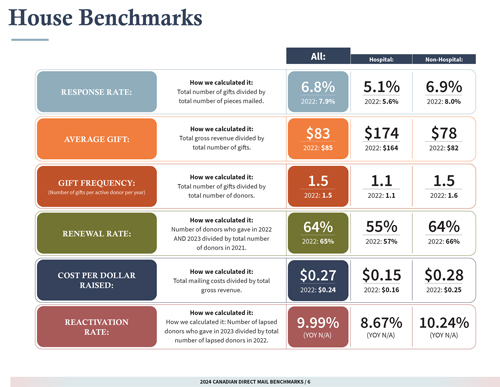
- The sector is still grappling with high paper and production costs. Combined with a 1-point drop in response rate, and a $2 dip in average gift, the cost per dollar raised grew by $0.03 to $0.27 in 2023.
- Charities who submitted multi-channel results data saw their direct mail revenue drop by the same amount that other channel revenue rose (14 percent).
- The data shows that charities mailed 2.3 percent more pieces this year. This, coupled with a decrease in House response rate, has us speculating that charities were mailing further back into their long-lapsed files in 2023, looking to reactivate more donors — who would, by their nature, have a lower response rate compared to active donors.
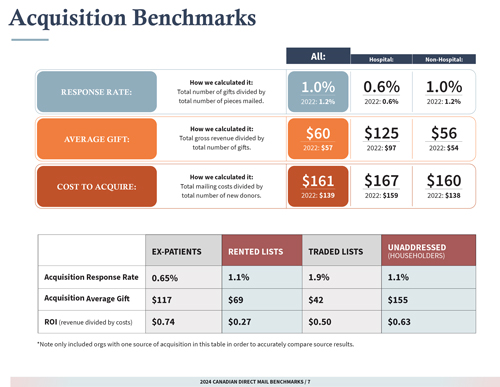
- It was more expensive to acquire a new donor through the mail in 2023. The cost to acquire rose 16 percent year-over-year to $161. With an average gift of $60 (which is up $3), this means that charities will now need three gifts from a new donor to break even.
- Rented and traded lists yielded the best acquisition response rates at 1.1 percent and 1.9 percent respectively, while ex-patient and unaddressed mailings boasted a higher average gift ($117 for ex-patients and $155 for unaddressed). If you care to grow your file in a meaningful way, your second-gift (or more importantly, third-gift!) conversion strategy has never been more crucial.
- As we look to a multi-channel approach, other channel response rates stayed relatively stable (a small decline of 0.3-points), while average gift rose by an impressive $16.
- Hospital foundations saw lower response rates than other charities. House donors responded at 5.1 percent for hospital foundations, compared to 6.9 percent for non-hospitals, while acquisition response rates were 0.6 percent compared to 1 percent for other causes. Even so, hospital foundations saw a smaller decline year-over-year than non-hospitals. The hospital foundation average gift, nearly $100 greater than the sector average at $174, yields a much lower cost per dollar raised.
- Hospital foundations are struggling to renew donors, with a 55 percent renewal rate compared to 64 percent and a gift frequency of 1.1 compared to 1.5 for non-hospital foundation donors.
The Participants
Let’s take a moment to send a cosmic hug, handshake, or high five to the 49 charities who made this report possible in 2024. These awesome organizations shared their time, their energy, and their 2023 direct mail results with us. They represent a mix of causes, organizational size, development team size, and revenue raised.
And they all share one thing in common: Their contribution makes the whole sector more informed and better understood as a result.


What the Hospital Foundation?
Almost across the board, hospital foundation benchmarks are lower than those for other causes. In past years’ reports, we’ve separated healthcare and nonhealthcare charities to provide benchmark clarity. Those groups tended to have different enough results that warranted splitting them.
This year, hospital foundation performance was so markedly different that we decided to separate that group from everyone else (including healthcare-adjacent charities) to give us a clearer picture of direct mail performance. In 2023, hospital foundation direct mail donors responded at a rate 1.8-points lower than their non-hospital counterparts.
Renewal rates were 9 percent lower, reactivation rates 1.6 percent lower, and gift frequency was 1.1 compared to the non-hospital 1.5.
What’s interesting though, is that hospital foundation response rates actually experienced less of a decline than other charities.
This is surprising, given that Canadians are feeling less confident in the health care system. Response rates could have plummeted, with donors shying away from giving to a system perceived as broken beyond repair — but they didn’t.
At the same time, hospital foundation donors are generous folks, who give nearly $100 more on average than other donors — and this gives hospital foundations a much more competitive cost per dollar raised of $0.15, where other charities are investing $0.28 to bring in $1.
Additionally, hospitals can use ex-patient prospects in their acquisition efforts, and those lists yield the greatest upfront ROI of any acquisition source, clocking in at $0.74.
About DM Benchmarks
A total of 49 charities provided us with direct mail results from 2022 and 2023, including total revenue, total costs, number of donors, number of gifts, and more.
Organizations had the option to provide us with “other” revenue results — that is, revenue that is driven by direct mail but is received through other channels. This includes donations from direct mail recipients who make their gifts via email, website, social media, and telemarketing.
By “House” donors, we mean those who have made a donation to the charity previously, no matter the year, amount, or frequency.
“Acquisition” donors are a purely prospective audience with no gift history with the organization.We asked organizations to exclude monthly donor data so as not to skew the number of gifts in a calendar year.
We can provide hospital foundation-specific benchmarks in this year’s report due to the large number of hospital participants. Wish we could do the same for your sub-sector? So do we!
Encourage your colleagues at similar orgs to share their results next year. If we have 10 or more charities for a given group, we can develop unique benchmarks.
And lastly, we’ll caution you against comparing the 2023 Benchmarks report to any that came before it. The charities who participate change year-over-year, meaning the dataset does too. When you see us reference year-over-year changes, we’re referring to results.
 Good Works is a full-service relational fundraising agency specializing in powering annual and legacy gifts through digital and direct mail. Their approach is grounded in loyalty, driven by data, and focused squarely on the future of fundraising. You can reach out to charlottef@goodworksco.ca to learn more.

Related Posts


